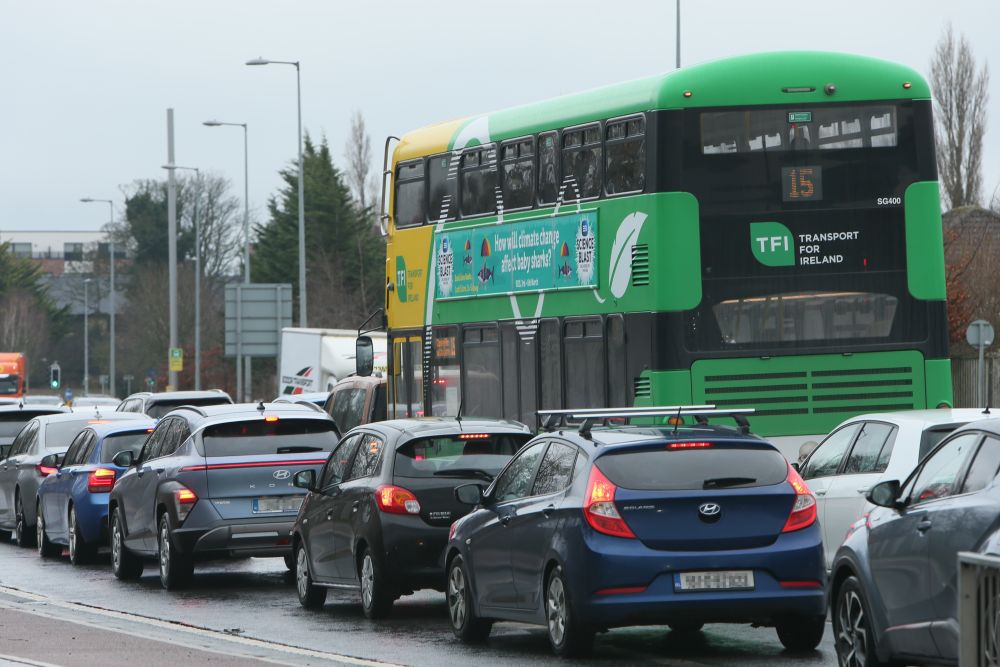

Dublin has climbed to become the 11th-most congested city in the world, according to a new global report that highlights worsening delays for motorists and mounting economic and social costs for the capital.
The findings come from Inrix, a US-based transport data and analytics company, which examined traffic conditions in 942 urban areas across 36 countries. The study is based on actual, observed journeys, rather than estimates, providing a detailed picture of how long drivers are spending stuck in traffic.
Dublin was identified as one of the major climbers in the rankings, rising four places from 15th last year. Drivers in the capital lost an average of 95 hours to congestion in 2025, a sharp 17 per cent increase on 2024, when delays stood at 81 hours. Compared with 2023, the rise is even more stark, with congestion up by 32 per cent over two years.
Despite improvements in some European capitals, Dublin remains the third-most congested city in Europe, behind only Paris and London. Notably, both of those cities recorded reductions in average delay times, while Dublin’s situation continued to deteriorate.
Outside the capital, Galway ranked as the 71st-most congested city globally, with motorists losing an average of 62 hours during the year. While still significant, this figure represents a 7 per cent decrease compared with 2024.
Globally, traffic congestion is continuing to worsen. Sixty-two per cent of cities analysed experienced an increase in delays, up from 55 per cent the previous year. Istanbul retained its position as the most congested city in the world, with drivers there losing an average of 118 hours annually.
In response to the report, the Department of Transport said it is “keenly aware” of Dublin’s congestion challenges. A spokeswoman acknowledged that while congestion carries a major economic burden, the personal toll is equally serious. She said encouraging a shift from private car use to public transport remains a core government priority, adding that significant investment in major transport projects is planned over the next five years.
Transport academic Professor Brian Caulfield, from Trinity College Dublin’s Centre for Transport Research, said Dublin’s ranking was unsurprising given the city’s rapid population growth. He stressed that congestion is not just about lost productivity. “It’s the people cost,” he said, “the partner left at home with the kids while the other spouse is stuck commuting and doesn’t get home until after bedtime.”
Professor Caulfield also warned of serious long-term economic consequences. The Department of Transport estimates congestion could cost more than €1.5 billion per year by 2040, a figure he said would damage Ireland’s competitiveness. “That level of gridlock makes it much harder to attract foreign direct investment,” he said, adding that “nobody wants to live in a city with both a housing crisis and a congestion crisis.”
He criticised what he described as a policy reversal away from prioritising public transport investment, arguing that ambition in this area has never fully recovered since the recession. Recent incidents, including a waste truck fire on the M50 and a power fault that halted Luas services, highlighted how fragile the system has become. “Our transport network is extremely vulnerable to shocks,” he warned. “We’re skating on thin ice, and if something fails, the whole city feels it.”
Despite the severity of the problem, major public transport projects such as the Dart+ South West and the Luas extension to Finglas have been delayed, leaving experts warning that meaningful relief may still be years away.